CARACTERIZACIÓN MORFOLÓGICA DE MICROFILARIAS ATíPICA Y OZZARDI DEL GÉNERO MANSONELLA
LORETO, PERU
Rev Peru Med Exp Salud Publica. 2012 Vol 29 (1)
jueves, 22 de marzo de 2012

jueves, 15 de marzo de 2012
Infection Landscapes: Strongyloidiasis
Infection Landscapes: Strongyloidiasis: This week at Infection Landscapes I am going to cover another nematode infection: strongyloidiasis. This infection is not nearly as prevale...
domingo, 11 de marzo de 2012
jueves, 8 de marzo de 2012
miércoles, 7 de marzo de 2012
Vigilancia Epidemiológica de influenza, de OVR e infecciones respiratorias agudas graves (IRAG) en el Perú 2012
Vigilancia Epidemiológica de influenza, de OVR e infecciones respiratorias agudas graves (IRAG) en el #Perú 2012
Ar t ículo 1°._ Aprobar la Directiva Sanitaria N°O'i.5-MINSAlDGE-V.01: "Directiva Sanitaria para la Vigilancia Epidemiológica de Influenza, de Otros Virus Respiratorios (OVR) e Infecciones Respiratorias Agudas Graves (IRAG) en el Perú", la misma que forma parte de la presente resolución.
jueves, 2 de febrero de 2012
martes, 31 de enero de 2012
miércoles, 21 de diciembre de 2011
First-Trimester Malaria: Treatment and Outcomes - Infectious Diseases
First-Trimester Malaria: Treatment and Outcomes - Infectious Diseases
Malaria during pregnancy has adverse effects, including maternal mortality, miscarriage, and low birthweight. During early pregnancy, treatment options are limited, especially in regions with drug resistance. In a retrospective study covering a 25-year period (1986–2010), investigators compared outcomes between women with a single episode of malaria during the first trimester and women without malaria during pregnancy. The women came from a camp for displaced persons in a remote rural area near the Thai–Burmese border.
Comment: These findings are reassuring with regard to the safety of artemisinin derivatives during the first trimester of pregnancy, despite animal studies suggesting potential embryo toxicity. Prospective studies in women are warranted. The present results clearly demonstrate the adverse consequences of malaria — whether asymptomatic or symptomatic — so testing and treatment during all stages of pregnancy should be part of malaria programs. Although both malarial and nonmalarial febrile illnesses are associated with increased risk for miscarriage during the first trimester, the pathological process underlying the increased miscarriage risk with asymptomatic malaria is unclear and likely malaria specific. As emphasized by editorialists, the risk from malaria clearly outweighs the theoretical risk from artemisinin treatment during early pregnancy.
Malaria during pregnancy has adverse effects, including maternal mortality, miscarriage, and low birthweight. During early pregnancy, treatment options are limited, especially in regions with drug resistance. In a retrospective study covering a 25-year period (1986–2010), investigators compared outcomes between women with a single episode of malaria during the first trimester and women without malaria during pregnancy. The women came from a camp for displaced persons in a remote rural area near the Thai–Burmese border.
Among 17,613 pregnant women, 945 (5%) had a single episode of malaria during the first trimester. Risk for miscarriage was increased by 2.7-fold in women with asymptomatic malaria — and by nearly 4-fold in those with symptomatic malaria — compared with uninfected women. Risk was similar between vivax and falciparum infections and was higher in women with hyperparasitemic or severe malaria. Other risk factors for miscarriage included smoking, maternal age  26, previous miscarriage, and nonmalarial febrile illness. Miscarriage risk was similar whether the woman was treated with chloroquine, quinine, or artesunate. No excess or specific fetal abnormalities were associated with artesunate-containing therapies, but the numbers available for this group were small (44 deliveries to artesunate recipients).
26, previous miscarriage, and nonmalarial febrile illness. Miscarriage risk was similar whether the woman was treated with chloroquine, quinine, or artesunate. No excess or specific fetal abnormalities were associated with artesunate-containing therapies, but the numbers available for this group were small (44 deliveries to artesunate recipients).
Published in Journal Watch Infectious Diseases December 14, 2011
CITATION(S):
McGready R et al. Adverse effects of falciparum and vivax malaria and the safety of antimalarial treatment in early pregnancy: A population-based study. Lancet Infect Dis 2011 Dec 13; [e-pub ahead of print]. (http://dx.doi.org/10.1016/S1473-3099(11)70339-5)
- Desai M and Dellicour S. Effects of malaria and its treatment in early pregnancy. Lancet Infect Dis 2011 Dec 13; [e-pub ahead of print]. (http://dx.doi.org/10.1016/S1473-3099(11)70345-0)
jueves, 8 de diciembre de 2011
Sx Pulmonar Hantavirus: 1° Caso que sobrevive en Loreto-Perú
Px mujer 38 años, Procedente de una comunidad en el Distrito de Mazan, sin antecedentes patológicos de importancia, con TE: 7 días.
 .
.
.
.
.
.
.
TEM toráx al ingreso: gran infiltrado alveolo-intersticial difuso bilateral
.
.
.
 La conducta:
Intubación Precoz y Ventilación Mecánica, así como CVC
Cobertura ATB
Inotrópicos
La Evolición:
Seguiremos actualizando: poco a poco
 |
Al ingreso a la emg del HRL polipneica, saturando 53%; se observa que no presenta inyección/sufusión conjuntival, ni ictericia (una característica en leptospirosis grave).
 |
Llamó la atención este esputo seroso sanguinolento.
Esto es muy importante:
"La Fuga capilar pulmonar es el sello de la infección por Hantavirus."
 .
..
.
.
.
.
TEM toráx al ingreso: gran infiltrado alveolo-intersticial difuso bilateral
"Los principales hallazgos histopatológicos en el SPH son la Neumonitis intersticial y el infiltrado de células mononucleares".
Dx de Ingreso:
Insuficiencia Respiratoria Aguda Grave: SDRA
dc Sx Pulmonar hantavirus
dc leptospirosis pulmonar grave (anictérica)
dc Malaria grave
Sx Febril Indiferenciado
.
.
.
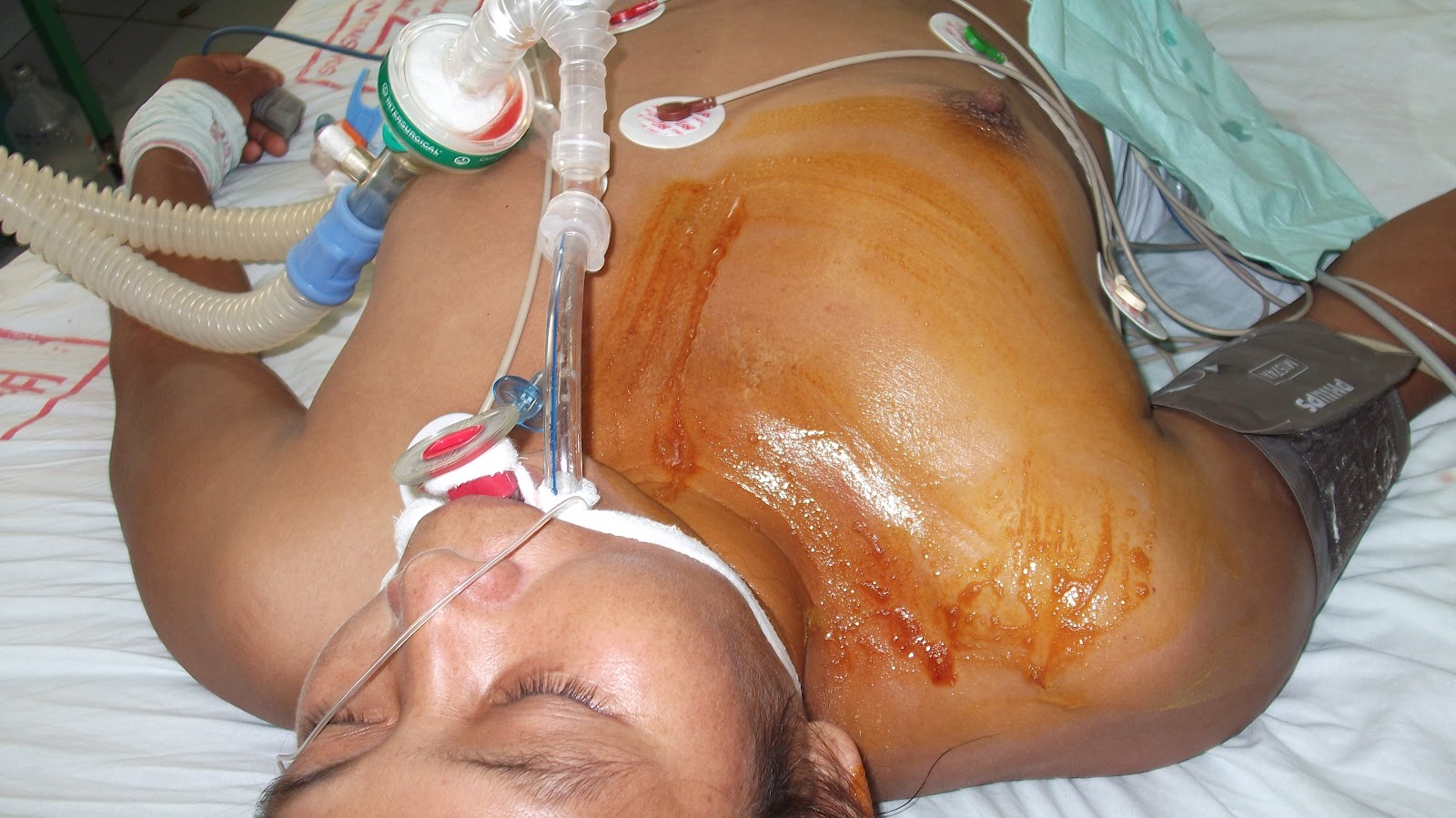
Intubación Precoz y Ventilación Mecánica, así como CVC
Cobertura ATB
Inotrópicos
La Evolición:
La paciente desarrolló rápidamente un shock refractario a inotrópicos las siguientes 12-24h; lo que requirió uso de 3 inotrópicos (dopamina, dobutamina e adrenalina)
miércoles, 7 de diciembre de 2011
Suscribirse a:
Entradas (Atom)